
CHRISTOPHER GADSDEN
AND THE LIBERTY TREE
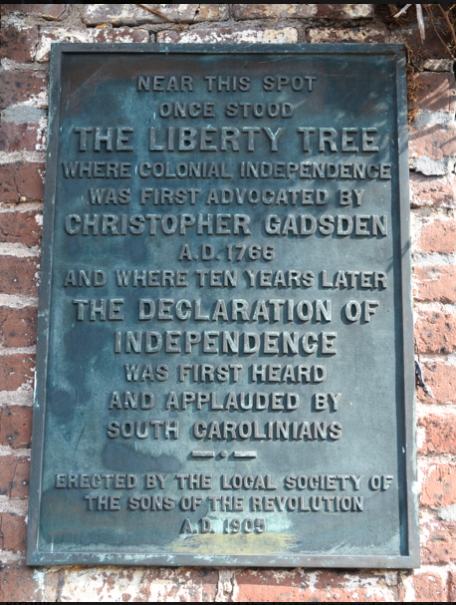
There’s a place on Alexander Street, just north of the Gailliard Center, marked with a small plaque that’s easy to drive past without ever noticing it. Though the live oak that once stood there is long gone, this is where the spirit of American patriotism took shape in Charles Town, fueled by a contentious radical named Christopher Gadsden.
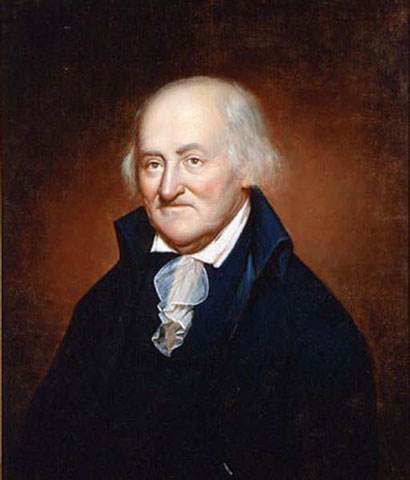
Gadsden was a full-fledged American patriot if there ever was one. He represented South Carolina at the 1765 Stamp Act Congress, First and Second Continental Congresses, and Constitutional Convention of 1787. Yet beyond this impressive resume, Gadsden was a man whose temper, bravery, confrontational nature, and commitment to his convictions and slavery have left him as what some might call a “forgotten founder.”
Christopher’s grandfather Edward Gadsden emigrated from England to Charles Town with his young son, Thomas, in 1695. Thomas grew up to be a Captain in the British Royal Navy before settling down here as a merchant and customs collector.
He married Elizabeth Terrey of Barbados in 1715. Christopher was their fifth child, born in Charles Town Feb. 19, 1724. Sadly, their first four children all died in childhood, as did their mother the year after Christopher’s birth. The Gadsdens’ gravestone can be found in St. Philip’s churchyard.
According to research by Dr. Nic Butler, historian at the Charleston County Public Library, in 1720 Thomas purchased about 64 acres of high land and 40 acres of marsh along the Cooper River, just north of the city wall. It was initially known as Bowling Green before he lost it in 1733 to Admiral George Anson to pay off his debts, after which the name changed to Ansonborough, as we know it today.
After completing his education in London, Christopher Gadsden eventually returned to Charles Town as a successful planter and shipping merchant. Not only did he import enslaved West Africans, he was a strong proponent of exporting enslaved Cherokees.
He married three times, all to prominent women. With these fortuitous marriages, an inheritance following his father’s death in 1741, and his own business success, Gadsden reclaimed his father’s estate in 1747.
He first sought public office in 1757 in the S.C. Commons House of Assembly, where he butted heads with several of South Carolina’s Royal Governors, according to Butler’s research. His separatist leanings surfaced again during his 1759 service in the Cherokee War when he denounced British Col. James Grant for taking command of local troops from provincial Col. Thomas Middleton.
Royal Gov. Thomas Boone refused to seat Gadsden when he was re-elected to the Commons House in 1762, claiming voting irregularities. The controversy resulted in Boone dissolving the house and reinforcing Gadsden’s disdain for the British.
Three years later, Gadsden established himself as an early proponent for a complete break with England at the Stamp Act Congress, where he vehemently opposed British taxes on paper ranging from court records to newspapers and playing cards. While his fellow delegates, John Rutledge and Thomas Lynch Sr., served on various committees seeking compromise, Gadsden refused to do likewise, saying the British Parliament had no right to govern or tax the colonies without representation, so there was nothing to negotiate.
Upon returning home, Gadsden announced he had joined the Sons of Liberty, a group including such luminaries as Samuel Adams, John Hancock, Paul Revere, and Benedict Arnold, who advocated civil disobedience, intimidation, and even violence to protest British taxes and rule.
Over the next several years, colonies from Boston to Savannah began debating politics at so-called Liberty Trees. In the fall of 1766, about two dozen working-class tradesmen in Charles Town did so under an old oak in Alexander Mazyck’s pasture, near today’s Alexander Street. Coincidentally (or perhaps not), the tree stood about 900 feet from Gadsden’s house.
These tradesmen saw an ally in Christopher Gadsden, a man sympathetic to the working class while establishing a bridge with elite Lowcountry planters and merchants, many of whom still sought to protect their financial interests by compromise with England rather than a full break.
Though no written accounts of what transpired at those meetings survive, a memoir written 50 years later by the group’s last living participant, George Flagg (1741 - 1824), recalled a meeting on Oct. 1, 1766, to celebrate the Stamp Act’s repeal.
Below a list of 26 names Flagg wrote: “On this occasion the above persons invited Mr. Gadsden to join them, and to meet at an oak tree just beyond Gadsden’s Green, over the Creek at Hampstead, to a [light meal] prepared at their joint expense for the occasion. Here they talked over the mischiefs which the Stamp Act would have induced, and congratulated each other on its repeal. On this occasion Mr. Gadsden delivered to them an address, stating their rights, and encouraging them to defend them against all foreign taxation. Upon which joining hands around the tree, they associated themselves as defenders and supporters of American Liberty, and from that time the oak was called Liberty Tree—and public meetings were occasionally holden there.”
That evening Gadsden gave a speech that “sobered their minds to the coming storm.” Revolution was coming.
According to research by Nic Butler, by 1774 Gadsden owned four stores, several ships, two rice plantations, a residential neighborhood we know today as Gadsdenboro on Charleston’s East Side, and one of the largest wharves in North America, today the site of the S.C. Aquarium, Liberty Square, and International African American Museum.
That year Gadsden was elected – along with Henry Middleton, Thomas Lynch Sr., and brothers John and Edward Rutledge – to represent the colony at the First Continental Congress. Among the most extreme separatists there, Gadsden urged delegates to reject all legislation enacted by Parliament since 1763 and attack any British warship off the American coastline. While many still sought to resolve their difficulties with England, Gadsden was ready for war.
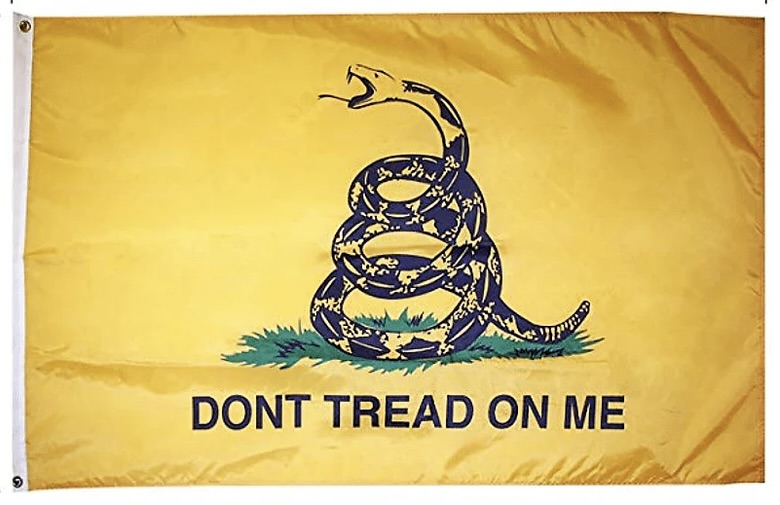
Gadsden also represented South Carolina in the Second Continental Congress, serving on the committee tasked with developing the U.S. Marine Corps. In December 1775, Gadsden presented them with a yellow flag featuring a coiled rattlesnake and the motto “Don’t Tread on Me.”
His use of the rattlesnake denotes a worthy adversary, one who warns you before striking. Yet when stepped upon, the snake’s bite can be deadly, one crosses it at one’s peril. The symbolism seems apropos for a man of Gadsden’s temperament. Even in today’s politically charged environment, Gadsden’s flag is often carried, as some did in the Jan. 6, 2021, attack on the U.S. Capitol, as a warning of violence should they be challenged.
Gadsden left the congress early in 1776 to command the 1st S.C. Regiment, preparing the colony for an inevitable British attack.
On June 28, 1776, nine British warships menaced Patriots in the incompleted Fort Sullivan (today Fort Moultrie). Gadsden, stationed at Fort Johnson on James Island, sent his men to build a bridge connecting Sullivan’s Island to Mt. Pleasant, providing Moultrie’s men an escape should it be necessary. Gadsden personally paid for the bridge’s construction. Today we know the site of that rebuilt, then abandoned, link as the Pitt Street Bridge in Mt. Pleasant’s Old Village.
A week later Congress approved by voice vote the Declaration of Independence. Though Gadsden’s dream of a full break with England was finally realized, his early departure from the Continental Congress meant he was not among South Carolina’s signatories to the Declaration.
While Gadsden’s fiery temperament served him well in advocating for war, it did not do so in the military. Duringa hot-headed exchange in 1777, Gadsden resigned
continiued next column

as brigadier general when Gen. Robert Howe, a North Carolinian, was given military authority in South Carolina, claiming that as a local officer, he should have had precedence.
Gadsden then turned his attention to helping develop the state’s constitution in 1778. On Jan. 24, 1780, he was appointed South Carolina’s vice president (a title soon changed to lieutenant governor) under S.C. President John Rutledge.
As British forces gained an advantage during the siege of Charles Town in April 1780, Gadsden was adamant that the Continental Army should not flee the city, an action that undoubtedly cost the lives of many before the city fell May 12. President Rutledge narrowly escaped to continue leading South Carolina’s Patriots while exiled. It fell to Gadsden, as the ranking civilian official, to hand over the city, the biggest surrender of the American Revolution.
British Gen. Henry Clinton had the Liberty Tree chopped down, and granted Patriot prisoners parole, somewhat akin to house arrest. When Gen. Charles Cornwallis relieved Clinton in August 1780, however, he sent 20 or so influential leaders, including Gadsden, to prison in St. Augustine, Fla.
There the British governor allowed prisoners to move about the city if they proved trustworthy. Nearly all accepted those terms. Yet true to his confrontational nature, Gadsden refused, saying the British had already reneged on one parole promise, and he would not give them the chance to do so again.
That defiance earned him 42 weeks of solitary confinement in Castillo de San Marcos, where the British threatened to hang him if the Patriots hanged Maj. John Andre for aiding Benedict Arnold’s plot to surrender West Point. The harsh conditions left Gadsden in poor health both physically and emotionally.
Charles Town’s leaders were released in a prisoner exchange in July 1781. Gadsden hurried home to resume his role as the state’s vice president. When Rutledge resigned as governor (this title replacing that of president) in January 1782, the position was offered to Gadsden. He declined, citing poor health.
Gadsden never fully recovered from his imprisonment. His last public service was at the Constitutional Convention of 1787 and later the Constitution’s adoption in South Carolina’s ratification hearings. On Aug. 28, 1805, he died of head injuries from an accidental fall.
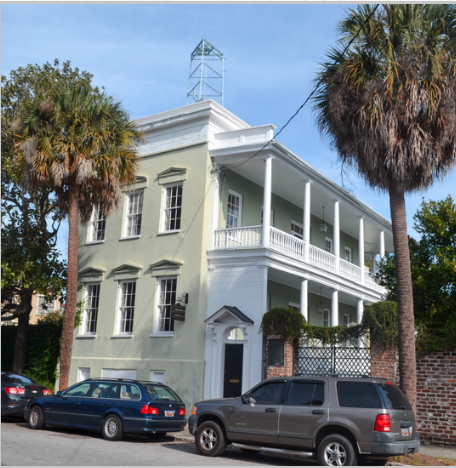
Meanwhile, Charlestonians dug up the stump and roots of their beloved Liberty Tree, making souvenirs of what remained, including a cane head presented to Thomas Jefferson. Over time, the tree’s exact location was forgotten. In 1905 however, S.C. Sons of the American Revolution placed a commemorative bronze plaque on a brick column at 80 Alexander St., believed to be about where it had stood.
Perhaps the next time you exit the parking garage of the county library’s downtown branch, look across Alexander Street for the plaque, and maybe take a moment to reflect on the passionate exchange of ideas there that helped shape our country.
