
DR. JOSEPH BROWN LAD
and the Code Duello
The eldest child of William and Sarah (neé Gardner) Ladd, Joseph Brown Ladd was born on a farm near Newport, R.I., on July 7, 1764, to a family of modest means. His father was a lieutenantin the American Revolution and in the Rhode Island state legislature.
Little documentation of Joseph's early years survives other than the inscription on his mother’s gravestone that notes “Studious in infancy, he was a favourite of the muses, and highly promising in his profession of physick ... His writings … display genious [sic], which riper years might have led to eminence.”
Joseph aspired to be something other than a farmer, someone who made his way in the world by using his intellect rather than by the toil of his hands; so as time away from agricultural chores allowed, Lt. Ladd “from time to time” sent his son to school in Newport where Joseph excelled in math, science, philosophy and classical literature. Even when on the farm, Joseph studied independently.
He published his first poem in a Newport newspaper when he was 10 years old, later adopting the pen name Arouet. At 15, he began studying medicine under Dr. Isaac Senter, earning his license in 1783.
He fell in love with a girl now remembered only as Amanda, an orphaned heiress financially and socially above his station. Nevertheless, Joseph pursued Amanda passionately, penning copious love poems to her.
Amanda’s guardians, whose financial control of her trust would end upon her marriage, thwarted the relationship by circulating rumors besmirching Ladd’s character which “though groundless, were so ingeniously devised … [as] to shake the confidence of some of his best friends,” wrote W.B. Chittenden in his preface for a collection of Ladd’s poetry.
As the gossip spread throughout Newport, Dr. Senter suggested it was time for Joseph to establish his own medical practice elsewhere and start with a clean slate. Ladd asked his friend, Gen. Nathanael Greene, a Revolutionary War hero who had campaigned in South Carolina, what advice he might have for a young man looking to establish himself in the medical profession.
At Gen. Greene’s suggestion, Joseph arrived in the thriving port city of Charleston in 1783 to establish himself in hopes of convincing Amanda to join him here.
Here he rented a room from sisters Fannie and Dellie Rose, spinsters who lived in the Thomas Rose House at 59 Church St. Though only 20, Ladd quickly established himself as a respected physician whose poetry frequently appeared in Charleston’s Columbian Herald.
Unfortunately, Ladd soon received news that Amanda had married another. Though heartbroken, his passion was unabated, and he continued to write poetry extolling his love for her.
Otherwise, Ladd thrived in Charleston. “Admired, esteemed, and beloved by a numerous circle in the highest ranks of society, and at the same time popular with the humbler class for his active benevolence; … no young man perhaps ever had a fairer prospect of rising to eminence …,” Chittenden writes.
Ladd was especially liked by his landladies who were charmed by his habit of whistling as he went about his work visiting patients around town. The Rose sisters were well ensconced in Charleston society and they introduced Ladd to their socially elite friends. Indeed, in 1785, Gov. William Moultrie invited the young doctor to address the Sons of Cincinnati at their July 4 Independence Day celebration. Ladd continued writing as well, publishing more than 70 poems in periodicals that included such readers as Benjamin Franklin, Thomas Jefferson and George Washington.
Among Ladd’s friends was Ralph Isaacs III who, as Joseph’s popularity grew, began to feel a sense of jealousy and resentment toward his friend’s quick rise within Charleston society. In October 1786, the two had a falling out, oral histories claim over the performance of an actress. Isaacs afterwards sought to disparage Ladd, calling him a “quack” and “social climber that cared only for money.”
Ladd had once before allowed unfounded accusations to force him out of town, and he was unwilling to run a second time. He responded to Isaacs’ accusations in the Charleston Mercury, affirming his good character and saying he was sorry they had ever been friends. Isaacs published a response calling Ladd “as blasted a scoundrel as ever disgraced humanity” and challenged him to prove his honor in a duel.
To 18th century Charlestonians, a man’s honor was a matter of utmost concern - and in Charleston, these types of offenses were settled with pistols under the code duello. Ladd’s friends insisted that this public offense must be answered, explaining that if he did not accept the challenge, Isaac’s accusations would carry the weight of truth.
It may be hard for us to understand the rationale behind dueling by today’s standards, but it was commonly accepted in 18th century Charleston. The issuance or acceptance of an invitation to duel was considered proof that a man was absolutely sure of the rightness of his claim, to the extent that he was willing to risk his life to prove it. The custom continued in South Carolina until at least 1840, years after it had been outlawed elsewhere.
Charleston’s code duello, with rules adapted from an ancient Irish tradition, was a formalized protocol that ensured a couple of things: one, that all avenues of compromise and agreement between the parties had been exhausted before any random or passionate violence spontaneously erupted from overheated emotions. Friends or family members known as “seconds” were appointed for each party to dispassionately meet and try to work out an understanding or retraction of the offense. In reality, this was often an effective way to settle a dispute once the parties’ tempers had abated and everyone had slept on the issue for a few calm nights.
Second, as weapons of the day were generally less effectively deadly than today’s, the code ensured that doctors would be on site to lend immediate medical attention. Having an arranged duel at a set time and place also ensured that witnesses would be present on behalf of both parties and that the facts of what ensued would not be left to uninformed gossip or (at least too much) exaggeration.
But most of all, the code duello ensured that the duel was fought fairly and that no side had an advantage over the other, regardless of wealth or social standing. One party selected a pair of weapons for the duel, while the other party had first pick of which of the equally paired weapon he would use. The seconds’ job was to inspect the weapons onsite and ensure that they were “clean” and that no trickery was involved.
And finally, as the opponents looked each other in the eye in the calmer light of several days following the offense, the code allowed both parties to give one hard last thought as to whether or not they were committed enough to their position to risk serious injury or death. Each party was allowed one shot, after which it was over regardless of the outcome.
Here it is key to note that this protocol provided a loophole that allowed both men to defend their honor to the point of risking their lives, but to exercise the option of a “missed” shot and thus avoid injury or death. Because of these safeguards, duels, while not uncommon, were rarely fought to the death.
When the seconds were unable to reach an agreement in Ladd's case, the duel was set for Oct. 23. Ladd spent the preceding night writing to Amanda, saying “friendly death may soon relieve my pain.” At dawn he and his witnesses arrived at the appointed site; though undocumented they may have met at the duelling grounds at what is now the College of Charleston Cistern or at what is now Hampton Park. Though most guides claim the duel was at Philadelphia Alley, research by Grahame Long, former curator at The Charleston Museum, failed to find documentation that duels were ever fought there.
Weapons were chosen, a last effort to compromise failed to do so, the opponents counted off the required number of paces. As the challenged party, Joseph had the first shot. He fired wide (some accounts say straight up into the air), hoping his former friend would do the same and they could call it a draw.
According to witnesses, Isaacs carefully took aim and shot the doctor squarely in the kneecap. Ladd fell to the ground screaming in agony and was carried back to the Roses’ house on Church Street. There he suffered in his second-floor bedroom for 10 days before succumbing to infection and blood loss on Nov. 2. He was just 22 years old.
A book of Ladd’s verses to Amanda, The Poems of Arouet, was published later that year. In 1832, Ladd’s sister, Elizabeth Ladd Haskins, submitted a broader collection of her brother’s poems to printer W.B. Chittenden, who published them under the title The literary remains of Joseph Brown Ladd, M.D. – A sketch of the Author’s Life. Today the collection is within the public domain and easily downloadable.
Some scholars consider Ladd to be among the more accomplished poets of 18th century America. One poem, “The Prospect of America,” Ladd inscribed “To the Second Fabius, His Excellency George Washington, Esq.,” though there is no documentation that the poem was inventoried within Washington’s Mount Vernon Library after his death.
And while the intent here is to share a historical account of the incident, suffice it to say that the historic marker erected by the Preservation Society of Charleston at 59 Church Street is the only one in this city - a city filled with ghost stories on nearly every street corner - to mention that the sound of whistling can still be heard on the dwelling’s staircase.
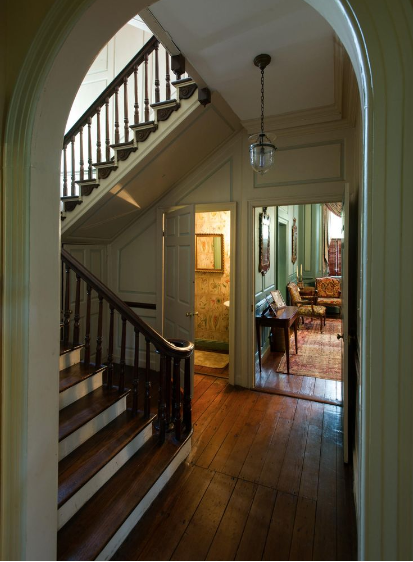
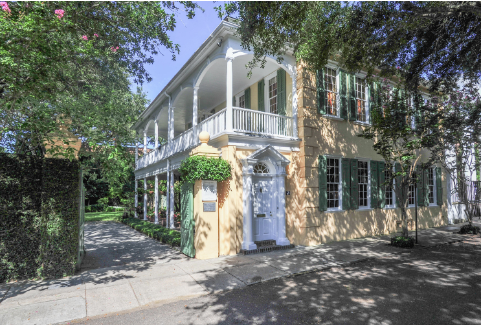
The Thomas Rose House, where Dr. Ladd died.
